

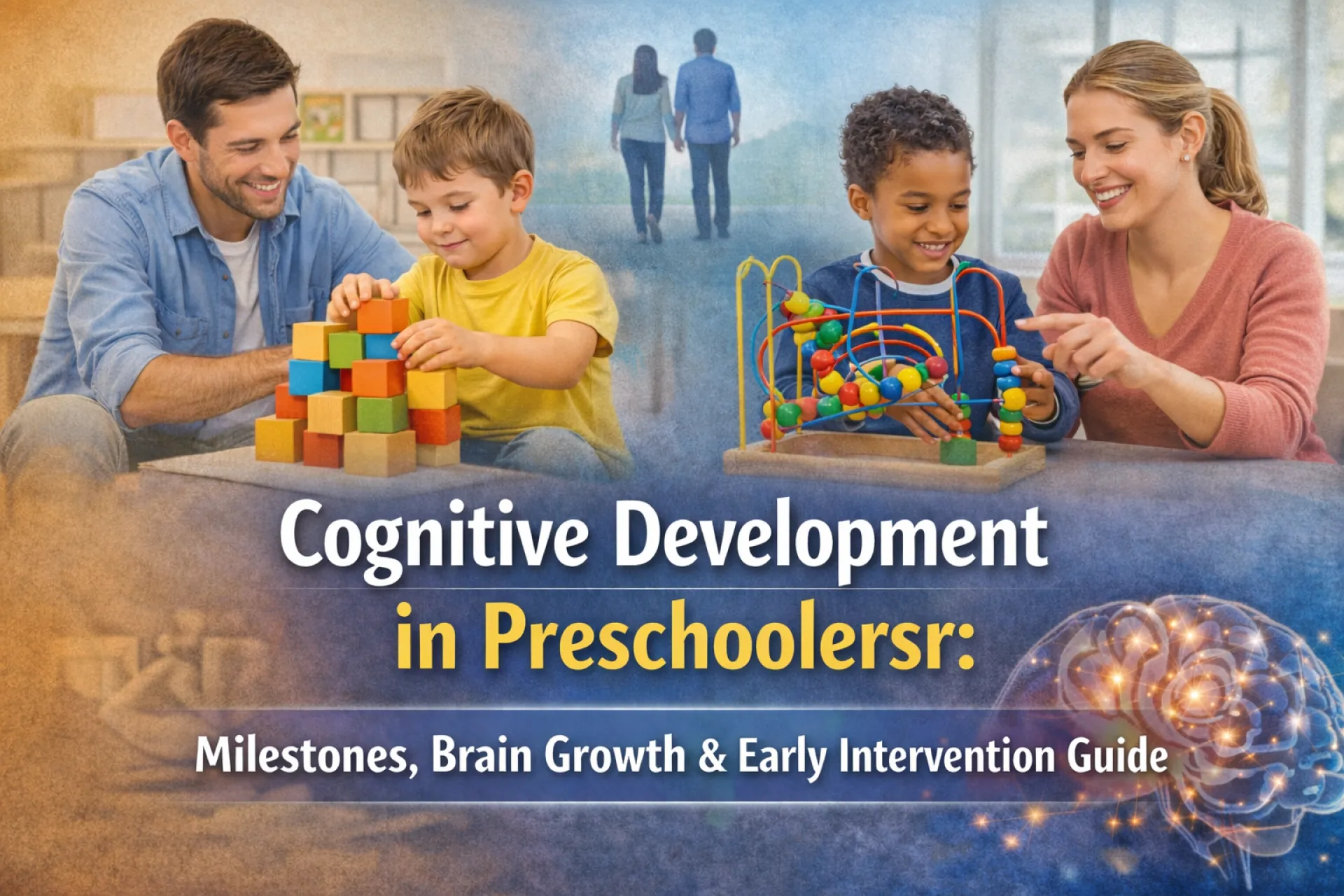
Early childhood is a period of extraordinary brain growth. Between ages 3 and 5, children develop the thinking skills that influence academic performance, emotional regulation, problem-solving ability, and even long-term career outcomes.
Understanding Cognitive Development in Preschoolersr is not just a parenting topic — it’s a public health, education, and mental wellness priority in countries like the United States, UK, Canada, and Australia.
In this comprehensive, research-based guide, you’ll learn:
-
What cognitive development really means
-
Brain science behind preschool learning
-
Key developmental milestones (ages 3–5)
-
Warning signs that may require evaluation
-
How parents can support healthy cognitive growth
-
When to seek professional help
-
Evidence-based early intervention strategies
This article follows YMYL standards because child development and mental health directly impact lifelong well-being.
What Is Cognitive Development?
Cognitive development refers to how children think, learn, remember, reason, and solve problems.
In preschool years, cognitive skills include:
-
Language development
-
Memory growth
-
Attention span
-
Problem-solving
-
Early math concepts
-
Imaginative thinking
-
Executive functioning
Research from the Centers for Disease Control and Prevention confirms that early cognitive development strongly predicts later academic success and emotional stability.
The Brain Science Behind Preschool Learning
According to the Harvard University Center on the Developing Child, 90% of brain development occurs before age five.
During preschool years:
-
Neural connections strengthen rapidly
-
The prefrontal cortex begins organizing executive function
-
Language centers expand dramatically
-
Emotional regulation systems mature
This period is known as a “sensitive window” for learning.
When discussing Cognitive Development in Preschoolersr, we are essentially discussing how experiences shape neural pathways that last a lifetime.
Key Cognitive Milestones (Ages 3–5)
Every child develops at a slightly different pace. However, developmental psychologists recognize common milestones.
Age 3 Cognitive Milestones
By age 3, many children can:
-
Follow simple two-step instructions
-
Sort objects by shape or color
-
Engage in pretend play
-
Ask “why” questions
-
Recognize familiar pictures
Imaginative play increases significantly at this stage.
Age 4 Cognitive Milestones
Around age 4, preschoolers often:
-
Understand counting concepts
-
Recognize some letters
-
Recall parts of stories
-
Begin logical reasoning
-
Understand cause and effect
Children at this stage begin building early literacy foundations critical for kindergarten readiness.
Age 5 Cognitive Milestones
By age 5, many children:
-
Count to 10 or beyond
-
Recognize most letters
-
Follow multi-step instructions
-
Understand time concepts (morning, night)
-
Solve simple problems independently
These skills form the base for academic success in elementary school.
The Role of Jean Piaget in Understanding Preschool Thinking
Cognitive development research was heavily influenced by Jean Piaget.
Piaget identified the “Preoperational Stage” (ages 2–7), where children:
-
Think symbolically
-
Engage in pretend play
-
Struggle with logical reasoning
-
View situations from their own perspective
Understanding this stage helps parents set realistic expectations.
Preschoolers are not being “difficult” — their brains are still organizing abstract thinking.
Executive Function: The Hidden Superpower
Executive function includes:
-
Working memory
-
Cognitive flexibility
-
Self-control
Strong executive function predicts:
-
Higher academic achievement
-
Better emotional regulation
-
Lower behavioral issues
-
Stronger decision-making skills
Many US early childhood programs now focus specifically on strengthening executive function because of its lifelong impact.
How Environment Impacts Cognitive Development
Cognitive Development in Preschoolersr does not happen in isolation. Environment plays a major role.
Positive Influences:
-
Responsive parenting
-
High-quality preschool education
-
Rich language exposure
-
Interactive play
-
Safe home environment
Programs like Head Start have shown measurable cognitive gains for children from low-income households.
Risk Factors That May Affect Development:
-
Chronic stress
-
Poverty
-
Neglect
-
Limited language interaction
-
Excessive screen time
-
Poor nutrition
Early intervention reduces long-term risk significantly.
Language Development and Cognitive Growth
Language is directly tied to cognitive development.
By age five, children in language-rich environments may hear millions more words than those without consistent verbal interaction.
Parents can support growth by:
-
Reading daily
-
Asking open-ended questions
-
Encouraging storytelling
-
Expanding vocabulary naturally
Strong early language development correlates with higher SAT scores and literacy performance later in life.
The Link Between Cognitive Development and Mental Health
Healthy cognitive growth supports:
-
Emotional regulation
-
Impulse control
-
Problem-solving under stress
-
Academic confidence
Delayed cognitive development can sometimes relate to:
-
ADHD
-
Learning disabilities
-
Speech delays
-
Autism spectrum conditions
If concerns arise, consult licensed pediatricians, child psychologists, or developmental specialists.
Early assessment does not label a child — it supports them.
Screen Time and Preschool Brain Development
The American Academy of Pediatrics recommends limiting screen time for preschool children.
Excessive passive screen use may:
-
Reduce attention span
-
Limit imaginative play
-
Affect language exposure
Interactive, educational content in moderation is generally acceptable.
Play: The Most Powerful Learning Tool
Play is not “just fun.” It is neurological training.
Types of play that enhance Cognitive Development in Preschoolersr:
-
Pretend play (builds imagination and empathy)
-
Puzzle play (strengthens problem-solving)
-
Building blocks (improves spatial reasoning)
-
Outdoor play (enhances executive function)
Unstructured play improves creativity and adaptability — essential life skills.
Signs a Preschooler May Need Professional Evaluation
Parents in the US, UK, Canada, and Australia should consider speaking with a professional if a child:
-
Does not speak in short sentences by age 4
-
Cannot follow simple instructions
-
Shows extreme difficulty with attention
-
Avoids eye contact consistently
-
Has no interest in pretend play
-
Struggles significantly with memory tasks
Early intervention services are widely available in first-tier countries and often covered by public health or insurance systems.
How Parents Can Support Cognitive Development at Home
1. Read Every Day
Even 10–15 minutes daily improves vocabulary and comprehension.
2. Encourage Curiosity
Answer “why” questions patiently.
3. Provide Problem-Solving Opportunities
Let children attempt tasks before stepping in.
4. Reduce Over-Structuring
Free play enhances independent thinking.
5. Maintain Predictable Routines
Consistency reduces stress and improves learning capacity.
The Role of Preschool Education
High-quality preschool programs improve:
-
Literacy readiness
-
Social skills
-
Executive functioning
-
Math foundations
Countries like Canada and Australia emphasize early childhood education funding because of long-term economic benefits.
Children who attend structured preschool programs are more likely to graduate high school and attend college.
Trauma and Cognitive Development
Exposure to toxic stress can affect brain development.
However, neuroplasticity allows healing through:
-
Stable caregiving
-
Therapy
-
Supportive educational environments
-
Safe attachment relationships
If trauma is suspected, seek trauma-informed therapy from licensed professionals.
Frequently Asked Questions
What is normal cognitive development for a 4-year-old?
A 4-year-old typically counts, engages in pretend play, follows instructions, and understands basic cause and effect.
Can cognitive delays be reversed?
Many delays improve significantly with early intervention, speech therapy, occupational therapy, and structured support.
How much screen time is safe?
The American Academy of Pediatrics suggests limiting screen use and prioritizing interactive engagement.
When should I worry about my preschooler’s learning?
Consult a pediatrician if milestones are significantly delayed compared to peers.
Why Cognitive Development Matters for Lifelong Success
Cognitive Development in Preschoolersr impacts:
-
Academic achievement
-
Career readiness
-
Emotional health
-
Financial stability
-
Relationship quality
Investing in early childhood development reduces long-term healthcare costs and strengthens national productivity.
This is why child development is considered both a parenting and public policy priority in high-income nations.
A Final Word for Parents
Preschool years are powerful,but they are not a race.
Every child develops at their own pace.
Your consistent support, emotional warmth, and engagement matter more than perfection.
If you have concerns, seek guidance from licensed professionals in your country. Early help leads to better outcomes.