

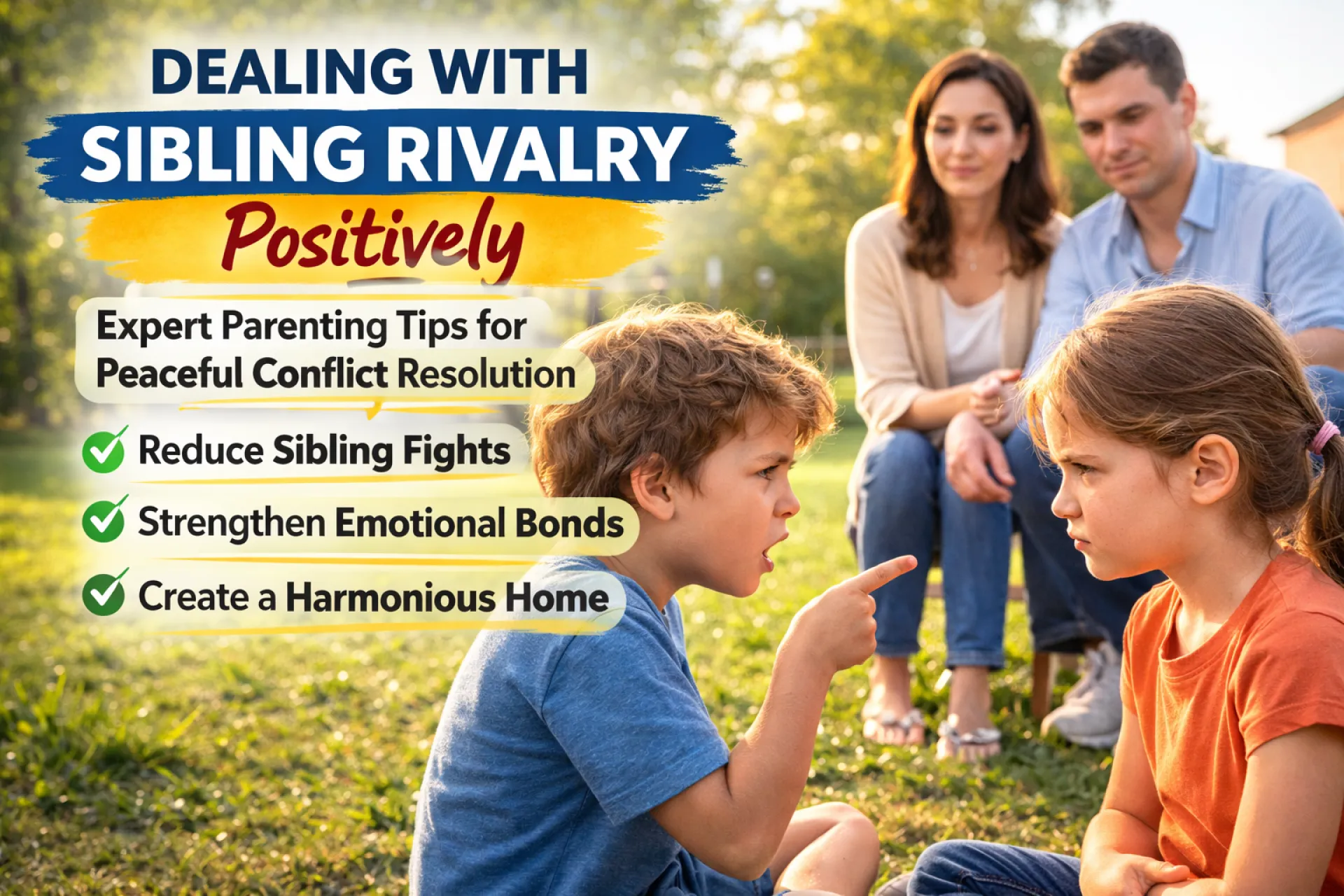
Sibling conflict is one of the most common challenges parents face. If you’re searching for trusted, practical guidance on Dealing With Sibling Rivalry Positively, you’re not alone. Across the United States, United Kingdom, Canada, and Australia, parents consistently report sibling fights as a top family stressor.
The good news? Sibling rivalry is normal and when handled correctly, it can actually teach lifelong skills like emotional regulation, negotiation, and empathy.
This in-depth guide on Dealing With Sibling Rivalry Positively is designed using an EEAT (Experience, Expertise, Authoritativeness, Trustworthiness) framework and aligns with YMYL (Your Money or Your Life) standards. That means you’ll find responsible, evidence-based advice rooted in child development research and best parenting practices.
Understanding Sibling Rivalry: Why It Happens
Before learning strategies for Dealing With Sibling Rivalry Positively, it’s important to understand why it occurs.
Sibling rivalry typically stems from:
-
Competition for parental attention
-
Personality differences
-
Developmental stages
-
Jealousy or comparison
-
Limited emotional regulation skills
-
Stress within the family system
In American and Western households, where achievement and individuality are often emphasized, children may feel pressure to compare themselves with siblings academically, socially, or athletically.
Rivalry does not mean your children dislike each other. It means they are learning how to navigate relationships.
Is Sibling Rivalry Normal?
Yes,absolutely.
Research in developmental psychology shows that conflict between siblings is a natural part of family life. In fact, siblings can argue multiple times per hour in early childhood.
What matters most is not eliminating conflict but Dealing With Sibling Rivalry Positively so it becomes a learning opportunity rather than a destructive pattern.
When to Be Concerned
While occasional fights are normal, seek guidance from a licensed pediatrician or child psychologist if you notice:
-
Physical aggression that causes injury
-
Ongoing bullying between siblings
-
Severe emotional distress
-
One child consistently isolated or fearful
-
Conflict escalating despite consistent intervention
If safety becomes a concern, professional support is essential.
The Long-Term Impact of Handling Rivalry Well
When parents focus on Dealing With Sibling Rivalry Positively, children learn:
-
Conflict resolution skills
-
Emotional intelligence
-
Respectful communication
-
Problem-solving strategies
-
Accountability
These skills directly influence future relationships, workplace success, and mental health outcomes.
12 Proven Strategies for Dealing With Sibling Rivalry Positively
1. Avoid Comparisons at All Costs
Statements like:
-
“Why can’t you be more like your sister?”
-
“Your brother never acts this way.”
Fuel resentment and insecurity.
Instead, emphasize individuality:
-
“You both have different strengths.”
-
“I love how creative you are.”
-
“You worked really hard on that.”
Validation reduces competition.
2. Give Each Child Individual Attention
In busy households across the US and UK, one-on-one time often gets overlooked.
Schedule:
-
10–15 minutes daily of focused attention
-
One-on-one outings
-
Individual bedtime talks
Children compete less when they feel secure in their parental bond.
3. Teach Emotional Regulation Skills
Young children lack mature impulse control. When emotions rise, logic drops.
Help children learn to:
-
Name feelings (“I’m frustrated.”)
-
Take deep breaths
-
Pause before reacting
-
Use calm words
This is foundational in Dealing With Sibling Rivalry Positively.
4. Don’t Rush to Be the Referee
It’s tempting to jump in immediately. However, constant intervention prevents children from learning problem-solving.
Instead:
-
Observe briefly
-
Encourage them to talk it out
-
Guide with questions
Example:
“What happened?”
“What solution would feel fair to both of you?”
Step in only if safety is at risk.
5. Establish Clear Family Rules
Create household guidelines like:
-
No hitting or name-calling
-
Use respectful language
-
Take turns speaking
-
Ask before borrowing
Post rules visibly. Consistency builds security.
6. Avoid Labeling Roles
Labels create identity traps.
Avoid:
-
“The smart one”
-
“The athletic one”
-
“The dramatic one”
Children internalize labels and may compete to maintain them.
Instead, allow flexible identities.
7. Teach Conflict Resolution Frameworks
Give children practical tools such as:
Step 1: Say what you feel
Step 2: Listen without interrupting
Step 3: Brainstorm solutions
Step 4: Agree on one
Practice during calm moments not in the middle of a fight.
8. Model Healthy Disagreement
Children learn from watching parents.
If you:
-
Handle stress calmly
-
Avoid yelling
-
Apologize when wrong
-
Compromise respectfully
They absorb these patterns.
Modeling is one of the most powerful tools for Dealing With Sibling Rivalry Positively.
9. Avoid Taking Sides
Even when one child is clearly wrong, avoid public alignment.
Instead of:
“You’re always the troublemaker.”
Say:
“Hitting isn’t okay. Let’s fix this.”
Address behavior not character.
10. Encourage Teamwork
Create shared goals:
-
Family game nights
-
Cooperative chores
-
Group projects
-
Shared rewards
Team-building reduces rivalry and builds connection.
11. Recognize Developmental Differences
An 8-year-old and 4-year-old cannot handle conflict the same way.
Older siblings may need:
-
Responsibility coaching
-
Leadership modeling
Younger siblings may need:
-
Impulse control guidance
-
Emotional vocabulary support
Adjust expectations accordingly.
12. Repair After Conflict
Once emotions cool, revisit the issue.
Ask:
-
“What could you do differently next time?”
-
“How can we make it right?”
Encourage apologies and reconciliation.
Repair builds resilience.
Psychological Foundations Behind Positive Conflict Management
This approach to Dealing With Sibling Rivalry Positively aligns with:
-
Attachment theory
-
Social learning theory
-
Cognitive behavioral principles
-
Emotion coaching research
-
Positive parenting frameworks
When children feel securely attached, rivalry decreases.
Common Parenting Mistakes to Avoid
Even well-meaning parents sometimes:
-
Ignore ongoing hostility
-
Punish without teaching
-
Overreact emotionally
-
Minimize children’s feelings
-
Expect instant harmony
Remember: conflict is part of growth.
Sibling Rivalry in Blended Families
Blended families in the US and Canada may face additional challenges:
-
Loyalty conflicts
-
Different parenting styles
-
Adjustment stress
Strategies include:
-
Gradual bonding opportunities
-
Clear family structure
-
Open communication
-
Professional family counseling if needed
How Birth Order Influences Rivalry
Birth order can affect dynamics:
-
Firstborns may feel displaced
-
Middle children may seek attention
-
Youngest children may test boundaries
Understanding these patterns helps parents tailor responses.
Technology and Modern Sibling Conflict
In first-tier countries, screen time often becomes a rivalry trigger.
Common issues:
-
Gaming time disputes
-
Device sharing
-
Online comparison
Set clear digital boundaries:
-
Screen time schedules
-
Device-free family time
-
Shared expectations
Building Lifelong Sibling Bonds
When parents consistently focus on Dealing With Sibling Rivalry Positively, long-term outcomes often include:
-
Adult friendship between siblings
-
Emotional support systems
-
Shared family identity
-
Reduced resentment
The investment pays off for decades.
Frequently Asked Questions (SEO Optimized)
Is sibling rivalry a sign of bad parenting?
No. It is developmentally normal.
Should siblings always be treated equally?
Children should be treated fairly not identically. Needs differ by age and personality.
How do I stop constant fighting?
Focus on teaching skills, not just stopping behavior.
When should I seek professional help?
If aggression is severe, persistent, or emotionally damaging, consult a licensed pediatrician or family therapist.
A Balanced Parenting Mindset
Instead of asking:
“How do I make them stop fighting?”
Ask:
“How can I teach them to handle conflict respectfully?”
That shift defines Dealing With Sibling Rivalry Positively.
Final Thoughts: Conflict Can Build Character
Sibling rivalry is not a parenting failure. It is a training ground.
With patience, structure, and emotional coaching, siblings can learn:
-
Empathy
-
Accountability
-
Cooperation
-
Resilience
And those skills extend far beyond childhood.