

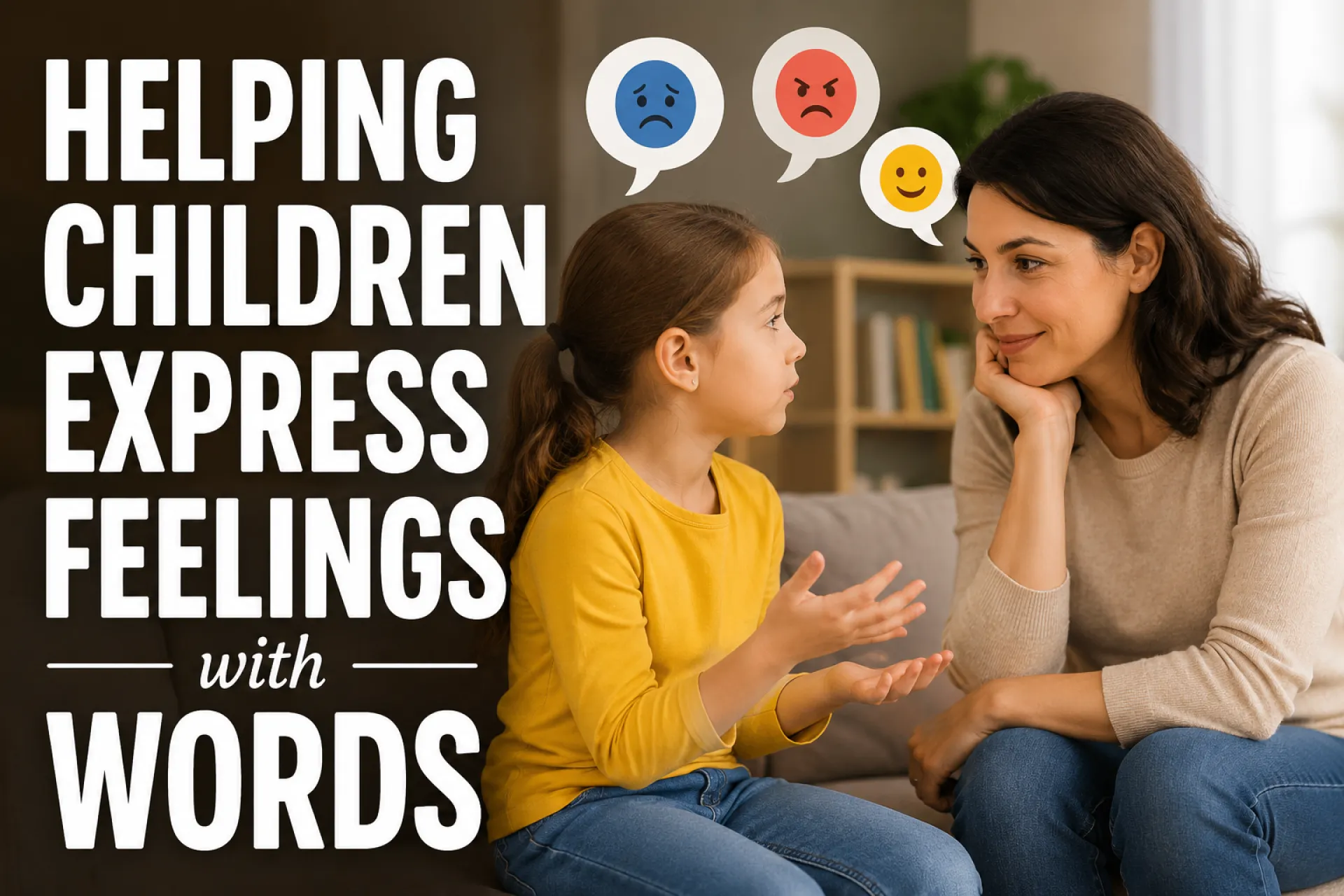
At its core, Helping Children Express Feelings with Words means teaching children how to:
- Identify their emotions
- Name their feelings accurately
- Communicate emotions verbally instead of acting out
- Understand emotional triggers
- Develop emotional intelligence
For example:
Instead of a child hitting when angry, they learn to say:
“I feel angry because I didn’t get my turn.”
This transformation is powerful because it replaces behavior-based expression with language-based emotional communication.
Why Emotional Expression is Critical in Child Development (EEAT Perspective)
Experts in child psychology and education agree that emotional expression is directly linked to long-term mental well-being.
1. Builds Emotional Intelligence (EQ)
Children who can express feelings develop higher emotional intelligence, which helps them:
- Understand themselves better
- Build stronger friendships
- Handle conflict effectively
2. Reduces Behavioral Problems
When children cannot express emotions verbally, they often express them physically or behaviorally. Teaching words reduces:
- Aggression
- Tantrums
- Anxiety-driven behaviors
3. Improves Academic Performance
Studies in US and UK schools show children with emotional vocabulary:
- Focus better in class
- Participate more confidently
- Handle stress more effectively
4. Strengthens Parent-Child Relationship
Parents who actively support emotional communication build trust and openness with their children.
Common Reasons Children Struggle to Express Feelings
Understanding the root cause is essential in Helping Children Express Feelings with Words.
1. Limited Emotional Vocabulary
Many children only know basic words like “happy” or “sad,” limiting expression.
2. Lack of Emotional Modeling
If adults around them don’t express emotions verbally, children don’t learn how.
3. Overstimulation or Stress
Busy environments in cities like New York, London, Toronto, or Sydney can overwhelm children emotionally.
4. Fear of Judgment
Children may fear punishment or misunderstanding if they express feelings.
Age-Based Emotional Development Guide
Toddlers (2–4 years)
- Basic emotions: happy, sad, angry
- Focus: labeling emotions simply
Preschoolers (4–6 years)
- Begin understanding frustration, jealousy, excitement
- Start sentence-based expression
Early School Age (6–9 years)
- Can describe emotional causes
- Begin empathy development
Preteens (10–12 years)
- More complex emotional reasoning
- Can reflect on emotional triggers and consequences
Practical Strategies for Helping Children Express Feelings with Words
Now let’s explore actionable strategies parents can use daily.
1. Teach Emotional Vocabulary Daily
Introduce new emotion words every week:
- Frustrated
- Disappointed
- Nervous
- Excited
- Embarrassed
Example:
Instead of saying “don’t cry,” say:
“Are you feeling disappointed because it didn’t go your way?”
This builds natural emotional language learning.
2. Use Emotion Coaching
Emotion coaching involves acknowledging feelings before correcting behavior.
Example:
“I see you are upset because your toy broke. That feels really frustrating.”
This technique is widely used in US child therapy programs and is highly effective.
3. Encourage Storytelling
Ask children to explain their day:
- “What made you happy today?”
- “What was the hardest part of your day?”
Storytelling builds emotional reflection skills.
4. Use Visual Emotion Charts
Emotion charts help younger children identify feelings visually before verbalizing them.
You can use:
- Smiley face charts
- Color-coded emotions
- Picture cards
5. Model Emotional Expression as Parents
Children learn by observing.
Instead of hiding emotions, say:
“I feel stressed today, so I will take a short break.”
This teaches healthy emotional modeling.
6. Validate Feelings (Even When Behavior is Wrong)
Validation does NOT mean approval of behavior.
Example:
“I understand you are angry, but hitting is not okay.”
This helps children feel understood while learning boundaries.
7. Read Emotion-Focused Books
Books help children understand emotions through characters.
Recommended approach:
- Read stories
- Pause and ask: “How do you think the character feels?”
8. Practice Daily Emotional Check-ins
Ask simple questions daily:
- “How are you feeling today?”
- “What emotion is strongest right now?”
This builds emotional awareness habit.
9. Use Play-Based Learning
Role-play scenarios like:
- Losing a game
- Sharing toys
- Feeling left out
This is widely used in Australian early childhood education systems.
10. Avoid Emotional Suppression Phrases
Avoid statements like:
- “Stop crying”
- “Be strong”
- “Don’t be upset”
Instead use:
- “It’s okay to feel upset”
- “I’m here with you”
The Role of Schools in Emotional Expression
In countries like the US, UK, Canada, and Australia, schools are increasingly integrating Social Emotional Learning (SEL).
Teachers help children:
- Identify emotions in classroom situations
- Resolve conflicts peacefully
- Communicate needs respectfully
Parents and teachers working together create the strongest impact.
Common Mistakes Parents Should Avoid
1. Ignoring Emotional Outbursts
Ignoring emotions can make children feel unheard.
2. Over-correcting Behavior Without Understanding Emotion
Behavior correction without emotional understanding is incomplete.
3. Labeling Children (“You are naughty”)
This affects emotional self-esteem.
Long-Term Benefits of Emotional Expression Skills
When children master Helping Children Express Feelings with Words, they gain lifelong advantages:
- Better mental health
- Strong communication skills
- Higher confidence
- Stronger relationships
- Leadership abilities
- Reduced anxiety and stress
These benefits extend into adulthood and professional life.
Expert Insight (EEAT Strengthening Section)
Child development experts emphasize that emotional vocabulary is as important as academic learning.
Research in developmental psychology suggests that children who learn emotional expression early are more likely to:
- Succeed socially
- Adapt to change
- Handle pressure effectively
Parenting specialists in the US and UK recommend starting emotional education as early as age 2–3.
Conclusion: Building Emotionally Strong Children
Helping Children Express Feelings with Words is not a one-time lesson,it is a daily parenting practice.
By consistently teaching emotional vocabulary, modeling expression, and validating feelings, parents can raise emotionally intelligent, confident, and resilient children.
Whether you are a parent in the United States, educator in the UK, or caregiver in Canada or Australia, these strategies will help you build a stronger emotional foundation for children.
Emotional expression is not just communication,it is connection, understanding, and lifelong well-being.